 By Susan Trudeau, Assistant Director of the Office of Service-Learning and Civic Engagement, University of North Florida
Susan Trudeau is a Campus Compact Innovation Fellow and recipient of a Lumina Foundation grant to take on projects and work meant to enhance the Newman Civic Fellowship program and support student civic development nationwide.
While we learned some things from our Campus Innovation Cohort project (redesigning our application project to reach the widest possible range of potential candidates), the most valuable lessons came from guiding our Newman Civic Fellow and a team of students she recruited through a project that we knew was likely to fail: restoring an election site to campus.
As educators, we rejoice in our students’ successes, and working with the talented and motivated students who are often nominated as Newman Civic Fellows brings to mentors a sense of pride and even actualization as we look forward to sharing their accomplishments. With that in mind, how do we stay the course when we know the project is unlikely to come to the desired outcome?
The University of North Florida (UNF) in Jacksonville utilizes a model that encourages Newman Fellows to create a team of students interested in their project; this team is then paid as student employees to support the project manager, the Newman Fellow. In 2023-2024, UNF’s dynamic and passionate Fellow chose a project focused on restoring a voting site to campus.
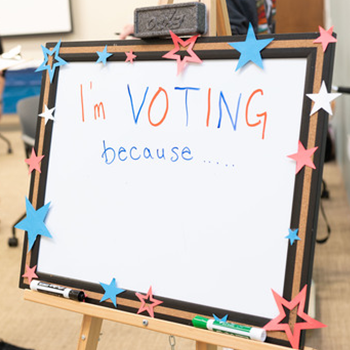 UNF lost its voting site after a poor turnout in 2016; student research determined that the site’s late addition to the slate of offerings and a lack of promotion by the Supervisor of Elections Office were major contributing factors. The Fellow proposed a project to collect research and garner community support for the site’s reopening and then planned to present that information to the Supervisor of Elections.
The Fellow and her team were immediately met with enthusiastic support from students, faculty, and staff as well as a number of local business and community organizations. The university’s president pledged to cover the facility costs, a major accomplishment. The site was toured and approved by accessibility experts. However, due to local political machinations out of reach of the students, as I expected, the polling site was not restored to campus.
Despite my suspicions from the outset that this project would not produce the desired outcome, I also recognized the value of the work – and the disappointment - for students who plan careers in public policy. The project had many facets across disciplines, including voter behavior research, land management, accessibility assessment, and cost analysis, among many others. The Fellow and her team would be required to negotiate with members of the university administration and local government. The students would develop skills vital to their success in professional life, but they would almost certainly complete much good work that would result in disappointment.
However, that reality should be in the job description of every position in public policy, and perhaps even in higher education student affairs: very good work often goes unrewarded and even unnoticed. These are hard lessons, but they are also important ones.
Most of the time, at least in instructional practice, learning from failure is an incremental process designed to eventually eliminate errors to create a successful final project. I was reasonably sure that this project was never going to be successful, regardless of how we adjusted or what we learned as we went along. Moreover, the concept of learning from failure often requires some metacognition from the students, recognizing a failure as it happens, adjusting the course, and trying again.
My students did not fail incrementally, and they only grew more excited with each accomplished step. It was up to me to make the value for them in the successes and in the eventual, final, heartbreaking catastrophic failure. I had to create that context against a backdrop of incremental success. I was a high school teacher before I moved to the higher education classroom and eventually administration, and I often deployed learn-from-failure strategies in my composition classroom. Even the strongest writers make mistakes and can learn from them.
But how should this methodology be used when the students are finding success after success? I must admit that I made it up as I went along, drawing on my educational background (and degree) and good-teacher instincts. It was only upon reflecting on the whole experience that I realized what a challenge it had been to buoy the students in the face of what felt like impending doom while guiding them through the learning.
The practical applications turned out to be tweaks of the familiar classroom pedagogy. I celebrated each success, careful not to tamp down their joy, but I ended every conversation by making sure they knew what the next steps were and why they were important. I made sure that the students prepared for the next step while the previous step was still fresh so that we could link the skill development from one step to the next.
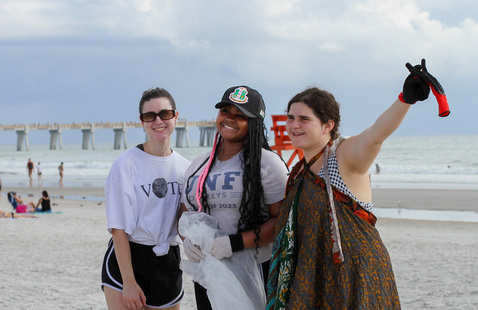 I also paused after each mini-party and asked the Fellow and her team to articulate what new skills they learned from the most recent aspect of the project. These two strategies required many more meetings than I expected to have to manage at the outset of the commitment, but the incremental reminders of their personal growth – separate from the achievement itself - made it easier to guide them to find value in the failure at the end. They each already had a list of what they had gained during the project, and only needed to be reminded.
I tried to manage expectations by using “if” rather than “when” language and balancing my congratulations at each new, promised resource and letter of support with a reminder of the aspects of the project that were out of their control. For example, the administration’s support was dependent on factors external to the individuals involved, no matter how wonderful they might be or the strength of the relationships the students had with them because those administrators are beholden to the state university system.
Rather than ask students to keep a log or reflection journal that they would submit at the conclusion of the project, I held informal reflection sessions, sometimes during lunch to cut down on my time spent, to discuss where we could value what had happened thus far, separate from the ultimate goal. These informal sessions were much more organic than the reflection questions that I had so carefully prepared at the project’s outset, and the results were so satisfying that I ended up abandoning my planned reporting structure for something altogether new.
And what I learned is also valuable and can be applied to my work in the Office of Service-Learning and Civic Engagement which sponsors student-driven projects: instead of redirecting students from a project unlikely to produce the desired outcome, I now feel confident to let the students spend my office’s valuable resources to try and still fail, when I used to think of those resources as wasted. I know that I can help students find value in a variety of experiences with a variety of outcomes.