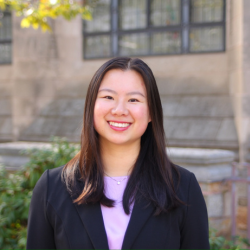
 By Julia Lin
Yale University
The Rural Youth Voices Initiative seeks to empower rural youth to better serve their communities, reshape dominant narratives about rural engagement, and encourage rural-serving organizations to center youth voices. Twelve Fellows from across the United States received $500 and support from Campus Compact to support a narrative change or civic engagement project in their community.
When you first step foot onto a college campus as a first-year student, it feels like a whole new world opens up. That was certainly the case for me when I arrived at Yale four years ago. The first questions you usually ask a stranger are their name, prospective major, and where they are from.
On my campus, I quickly noticed that most of the people I met grew up in big cities like New York, San Francisco, Boston, or Chicago. When asked where I’m from, I usually replied that I grew up about an hour from Washington, D.C. to give my peers a reference point. My name is Julia Lin, and I’m a senior at Yale University. I grew up in Walkersville and Thurmont, Maryland, which are both small towns of about 6,000 people.
As I spent more time at Yale and started getting to know my peers better, I realized just how different our lived experiences were. Many of their parents worked as investment bankers, consultants, doctors, or lawyers. They went to high schools where almost everyone headed to highly selective colleges.
Back home, my classmates’ parents were veterans, farmers, teachers, nurses, and police officers. After graduating from high school, most of my classmates went straight into the workforce, joined the military, or attended community college. Now, they are making a life for themselves in our small town.
The transition from my small town to Yale was significant and quite difficult. I struggled my first-year wondering if I belonged. However, as I became more familiar with the campus, I began to realize the unique perspective I bring.
Some of my favorite memories are conversations where my peers ask me what it was like to grow up in a small town. No, my parents are not farmers. Yes, I grew up on a farm with horses, goats, and chickens. Yes, I know how to drive a tractor. In fact, my high school had a “drive your tractor to school” day. My peers seemed mystified at first but also fascinated with the way I grew up. As I began to develop those relationships, I started having the opportunity to complicate their assumptions about rural America.
With the support of Campus Compact as a Rural Youth Voices Fellow, I have had the opportunity to develop and work on a project that I am passionate about. I strongly believe that students from rural areas bring unique perspectives that are necessary to college campuses. College is often one of the most formative experiences for people because students from all walks of life are brought together into one space.
The rural perspective has often been left out. It is time to change that. Thus, my project involves collecting testimonials from students who grew up in small towns and are now attending schools in the STARS College Network.
For those who are not familiar with the incredible work of the STARS College Network, STARS has committed more than $150 million to recruit, support, and graduate students from rural America. Currently, 32 colleges and universities are participating in the network. Applicants from small towns face unique challenges when applying to college. For one, some can not even imagine a four-year college as a path due to the lack of outreach. Others may be concerned about affordability. This is why it’s important to dedicate funding to address these barriers.
It’s my hope that the testimonials I collected highlight the value that rural students bring to college campuses. Rural students don’t just add diversity of thought to the classroom but also in dining halls, student clubs, and late-night conversations with friends. Oftentimes, selective universities can be an echo chamber. Some students may have never had a conversation with someone from rural America and instead rely on stereotypes shaped by the media. A college campus might be the first time they can connect with someone from a completely different walk of life. That is powerful.
What is my ask? Keep an open mind. Students from rural America are so much more than farms. We are smart, curious, and eager to learn from others. We offer a unique perspective. Don’t count us out. We belong on college campuses too.
The testimonials I collected can be viewed here. If you’d like to connect about my project, feel free to email me — I’d love to hear from you!