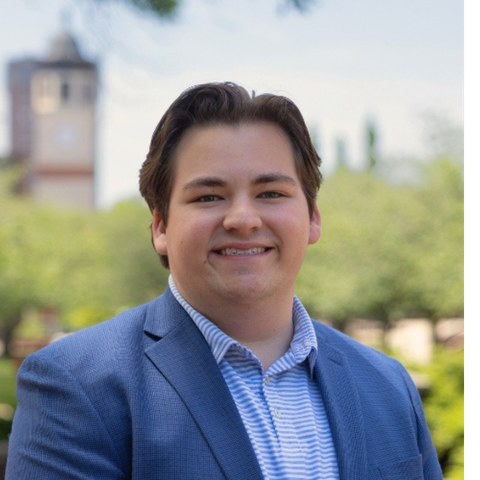
 By Caden Lucas
Rural Youth Voices Initiative
Western Kentucky University
Published as part of Letters to America, a national youth-driven civic initiative launched by Made By Us through Youth250, in which young people put forward their own declaration for America’s 250th anniversary. These letters are published unedited and in full to showcase the students’ authentic voices and unique perspectives. While their views are entirely their own, we believe their voices, and those of all our student leaders, are a vital part of the conversation around America’s future.
Dear America,
In a small town in rural Kentucky, Independence Day has always felt a little different. For me, it is the smell of fireworks drifting across hay fields. It is church picnics and county fairs with children gathered on star-spangled blankets. It is families gathered together watching the sky light up above communities where everybody knows everybody. For much of my life, that was America.
As a kid, I grew up believing in this country. Not because I thought it was perfect, but because I was taught that it was worth believing in. I learned that America was an idea as much as it was a place. That liberty, equality, self-government, and opportunity were not guarantees, but aspirations for us all to work toward. They were promises made by imperfect people to future generations.
Now, as you approach your 250th birthday, I find myself reflecting on those promises and wondering what they require of us today. Over the last several years, I have dedicated much of my life to civic engagement, democracy, and public service. I have registered voters, helped lead community organizations, studied history and government, and worked alongside people trying to solve problems in the rural American landscape that is too often overlooked by the national conversation. What I have learned is a simple truth: the greatest threat to democracy is not disagreement, but disengagement.
Disagreement is natural. In fact, it is essential. Every generation of Americans has disagreed about what this nation is and what it ought to become. Democracy has never required uniformity, but it has always required participation. Have we abandoned this self-evident truth?
In many rural communities like the one where I grew up, democracy feels distant. Decisions feel like they are made somewhere else by people you will never meet. The public institutions we are taught to trust feel disconnected from daily life. Many people feel forgotten, unheard, or convinced that their participation no longer matters. Perhaps most concerning of all, many people have become afraid. Somewhere along the way, shame became a political tool. We no longer sort ourselves into camps based on what we believe, but by whom we distrust. The result of the actions of generations past is a nation growing increasingly skeptical not only of its people, but of itself.
And yet, right alongside that disengagement, I have witnessed something extraordinary. I have watched neighbors organize after tornadoes, volunteers rebuild community spaces, and local leaders devote countless hours to solving problems because they care about the people around them. I have seen enough to know that America is still alive in the places where people choose to show up for one another.
This is why I continue to believe in you. Not because of what you have already achieved, but because of what remains possible. As a result, I continue to return to a single phrase from the Declaration of Independence: "We hold these truths to be self-evident." The phrase has always fascinated me because self-evident does not mean self-executing. The ideals of equality, liberty, and self-government do not sustain themselves. Every generation must choose to believe in them and bring them closer to reality.
Throughout our shared history, Americans have had to fight, organize, advocate, vote, march, teach, serve, and sacrifice to bring those principles closer to reality. After all, the Declaration of Independence did not complete the American story; it merely showed us the beginnings. Its authors handed us a set of ideals and a challenge to make them real. Every generation since has inherited that responsibility.
Now, I do not find myself asking whether your history is flawless or whether your promises have always been fulfilled. They are not, and they have not. Instead, I find myself asking whether we still believe in them. Do we still believe in equality, liberty, self-government, and the idea that our neighbors are fellow citizens before they are political opponents?
I hope we do. Despite the division that dominates our headlines, I remain convinced that Americans share far more than we are led to believe. Most people want safe communities, meaningful opportunities, good government, and a future brighter than the present. Most people are capable of good faith and far more compassionate than the caricatures we create of one another. Most importantly, I believe America remains capable of becoming more fully herself. That, to me, is patriotism. A stubborn faith that this country is worth the work required to improve it.
For 250 years, generation after generation has inherited an unfinished promise and carried it forward. My hope is that we will do the same. That we will reject any cynicism masquerading as wisdom. That we will choose participation over apathy, curiosity over contempt, and service over self-interest. That we will continue the difficult work of transforming self-evident truths into lived realities.
For 250 years, America has been sustained by citizens who believed this nation could become more than it was. May we prove worthy of that inheritance.
With hope,
Caden