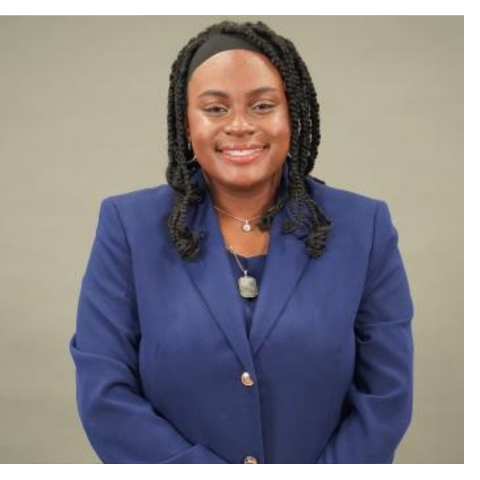
 By: Tanasha Jackson
University of North Florida
2024-2025
When I began my Newman Civic Fellowship, I thought I was taking on a leadership project. I didn’t realize I was stepping into a healing journey—one shaped by personal loss, student solidarity, and the radical act of holding space for people who often feel invisible.
My mini-grant project, First-Generation Ospreys: Empowering College Success, was created to support first-generation students at the University of North Florida (UNF). Nearly 48.4% of UNF’s student body identifies as first-gen, yet until now, there was no central platform, programming, or peer group dedicated to uplifting this community.
But this wasn’t just a gap I saw as a student leader. It was a silence I carried in my bones.
A Project Born of Grief—and Love
This project was born out of grief and love—for a man who never got to cross the graduation stage. In September 2024, during the earliest days of my Fellowship, I lost my father in hospice care. He was a first-generation college student who worked over 40 hours a week while trying to complete his degree. Despite his determination, the systems designed to support student success didn’t meet him where he was. He eventually had to walk away from college—not because he lacked the will, but because he lacked the network, guidance, and safety net that other students often take for granted.
My mother, also a first-gen student, did graduate. But her experience, too, was marked by solitude. She never had access to networking, mentorship, or the kind of community that builds confidence. Both of my parents were Black commuter students at a predominantly white institution, navigating campus while raising younger siblings, holding down jobs, and masking how overwhelmed they felt.
In their stories, I saw a larger pattern: first-generation students are often made to feel like they’re behind, when in reality, they’ve just been unsupported.
Filling the Gaps My Parents Faced
At UNF, I couldn’t ignore the disconnect between how many first-gen students were on campus and how little was being offered to them. Many didn’t even realize they were first-gen until they heard someone name the term out loud. There were no tailored workshops, no digital resource hubs, no peer groups to normalize the experience. Just a quiet ache that I knew too well.
With the support of my project mentor, Susan Trudeau of the Office of Service-Learning and Civic Engagement, I began building First-Generation Ospreys—a multi-platform initiative to meet students where they are, both digitally and emotionally.
We started with a self-paced Canvas module, created in January 2025, which housed key resources like scholarship tools, FAFSA guidance, student voice videos, and curated links to campus services. But I quickly realized that information alone wasn’t enough. What students needed—what I needed—was connection.
Community x Digital Connection
To reach students beyond the classroom, I leaned into the power of Instagram. It became a central hub for visibility, affirmation, and storytelling. I used reels, quotes, event promos, and student testimonials to create a shared language around the first-gen experience. Rather than presenting first-gen identity as a deficit, I reframed it as a badge of resilience. I wanted students to feel proud—not embarrassed—when they said, “I’m first-gen.” Engagement grew naturally. Students began messaging me, commenting, sharing their own stories, and asking how they could help.
The Canvas module became the sustainable core, but Instagram was the heartbeat. Together, they formed a digital bridge: one that gave students both quick wins and deeper reflection.
First-Gen Osprey Week: A Cultural Shift
In April 2025, we launched First-Generation Osprey Week, a campus-wide visibility campaign and event series that turned ideas into action. It was the heart of the project—a chance to bring our growing digital community into real-life spaces.
We kicked off the week with “Let’s Taco About It”, a student-led survival guide session paired with free food and candid conversation. Students shared their struggles navigating registration, office hours, and financial aid—and just as importantly, they shared what had helped them survive.
The week continued with creative journaling workshops, tabling events, and our highest-attended session, “Speed Friending.” Nearly 40 students came out to that mixer. Many of them had never met another first-gen student before. What I witnessed that night was nothing short of transformational: students finding language for their experience, discovering solidarity, and walking away with not just resources—but real friends.
One student said, “I didn’t even know I was first-gen until this week. I just thought I was behind.” Another said, “This is the first time I’ve said it out loud. It feels good to not be the only one.” That’s when I knew this wasn’t just programming. It was a cultural shift.
Quality Over Quantity
As the project unfolded, I found myself reflecting often on what impact really means. In a world that measures success by numbers, I discovered that intimacy and intention were far more powerful. The most fulfilling parts of this journey didn’t happen in front of large audiences. They happened in small groups—after events, during check-ins, through long DMs and quiet hugs.
In those spaces, students opened up. We cried, we laughed, we admitted we were tired. And that vulnerability was the beginning of real connection. I learned that leadership isn’t always loud—it’s often listening, showing up, and making others feel safe enough to stay.
A Living Legacy
The response to this project exceeded anything I imagined. Faculty have asked to use the module in orientation. Local nonprofits and high school programs reached out, asking for access to the materials. Students began asking how to keep the work going. Some even offered to form a First-Generation Ospreys club to sustain the momentum.
But perhaps the most powerful shift was internal. In helping others feel less alone, I started to feel less alone, too. I realized that my grief didn’t weaken this project—it gave it depth. Every event I hosted, every message I sent, every connection I nurtured was an act of remembrance and continuation.
Gratitude and What’s Next
I am incredibly grateful to Campus Compact, The Allstate Foundation, and the mentors and students who stood beside me throughout this process. Special thanks to Susan Trudeau for walking with me through planning, loss, execution, and reflection. Thank you to UNF’s Black Thought Club, NAACP, and every student who said “yes” to being part of this vision.
Moving forward, I hope to expand this project into a standing student organization, formalize mentorship pairings, and explore the creation of a first-gen living-learning community on campus. I want this work to ripple outward—to policy, to curriculum, to spaces that still treat first-gen identity as a silent struggle rather than a story worth celebrating.
This was more than a mini-grant. It was a promise to my father, a gift to my peers, and a foundation for future students who deserve to be seen, supported, and celebrated.
About the Author
Tanasha Jackson is a double major in Africana Studies and Spanish at the University of North Florida. She is a 2024–2025 Newman Civic Fellow and a passionate advocate for first-generation students, Black archival storytelling, and community-driven education.