February 11 & 12th marked Campus Compact’s 3rd annual Presidents Policy & Impact Summit, which brings college and university presidents together in Washington, DC to discuss shared priorities—ensuring civic and community engagement remains central to our institutions’ missions, building a new era of dialogue and progress with elected officials, and moving toward a more unified strategy across campuses. This year’s summit was hosted by The George Washington University.
Due to the congressional voting schedule, planned appearances by members of Congress were necessarily limited, but the Summit featured rich conversations from a wide variety of perspectives and offered presidents, chancellors, and other campus leaders time to have strategic conversations about how to progress our shared goals.
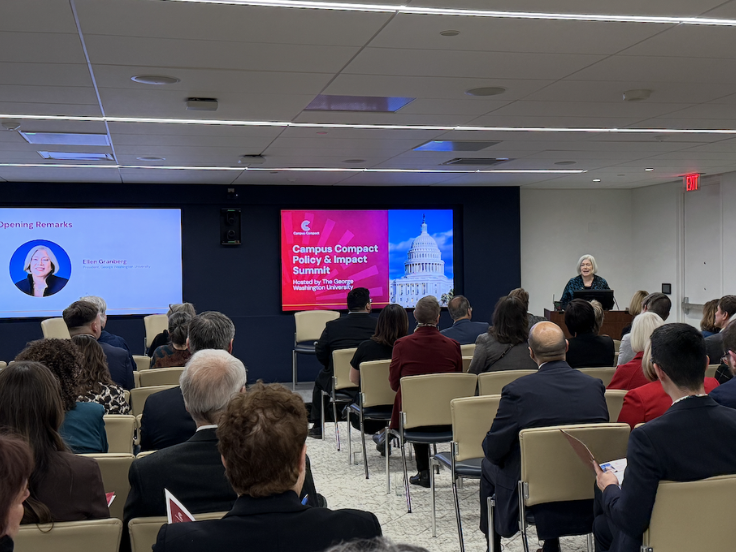
Opening panel: Conversation with Campus Leaders and Remarks from Congresswoman Sarah Elfreth
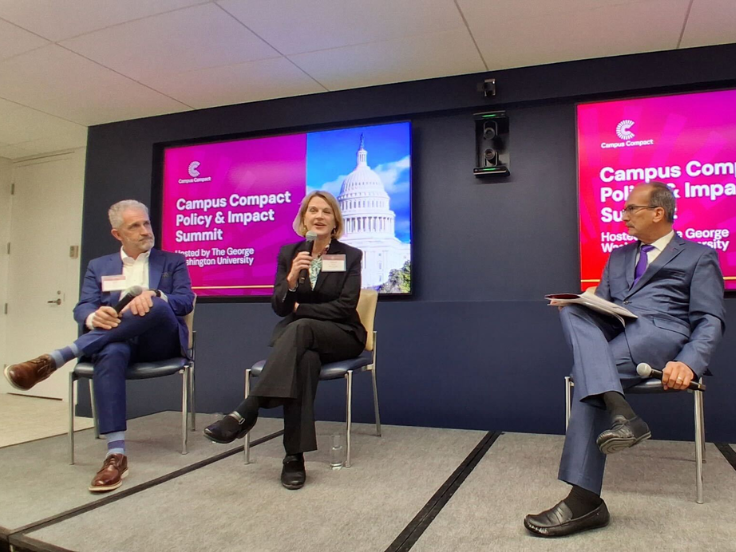
The Summit kicked off with a great conversation between three campus leaders: Havidán Rodríguez, president of the University at Albany, Cheryl Nixon, president of Berea College, and Lane Glenn, president of Northern Essex Community College. Discussion focused on their personal connection to public service, how a commitment to public service shapes their roles as higher education leaders, and the importance of higher education in shaping the next generation of civic leaders. We were so grateful to them for stepping in at the last minute to share such relevant insights.
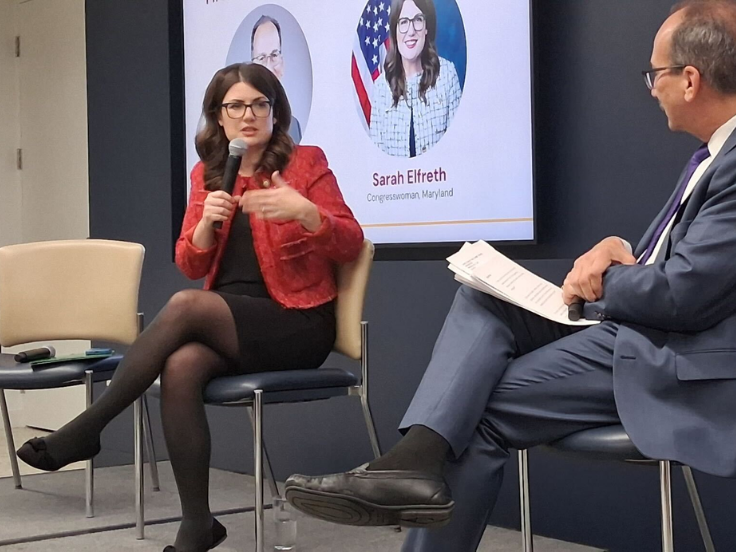
Once voting concluded for the day on Capitol Hill, we were joined by Congresswoman Sarah Elfreth, who represents Maryland’s 3rd congressional district. She talked about the importance of higher education and how her time at Towson University shaped her personal path to public service, and how vital it is in shaping future civic leaders, particularly related to listening to and creating opportunities for authentic student leadership and co-governance. She shared some insights about how important it is to be involved in the community and to hear directly from the individuals you aim to serve and that higher education needs to double down on centering civic engagement through civic engaged teaching, civic education, and creating civic action opportunities. We are so grateful to Congresswoman Elfreth for joining us after such a long day of voting, and for her leadership in our democracy.
Panel: Work in Action: Presidential Perspectives
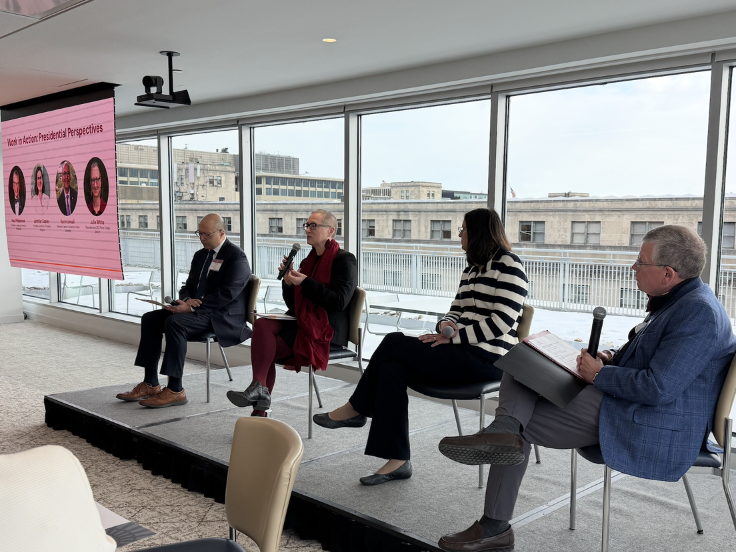
“We try to adopt an attitude of ‘yes.’ If a community organization asks, the answer is yes. If a local government asks, the answer is yes. And so, just creating that spirit of saying, we’re here, we don’t know all the needs our community has, but we want to figure it out.”
- Jennifer Cowley, president of The University of Texas at Arlington
This panel brought together four college presidents working in different contexts across the country to explore how they are preparing civic-minded students, engaging with pressing civic issues, and navigating the current political climate. The panel was moderated by Paul Pribbenow, president of Augsburg University, and panelists included Julie White, Chancellor of Pierce College, Karim Ismaili, president of Eastern Connecticut State University, and Jennifer Cowley, president of the University of Texas at Arlington.
Panelists discussed a wide range of issues, from challenges related to academic freedom in today’s climate, how colleges and universities can bridge the educational attainment gap, and the ways that higher education can instill civic values in students.
Panel: Civic Engagement Opportunities & Public Service Pathways
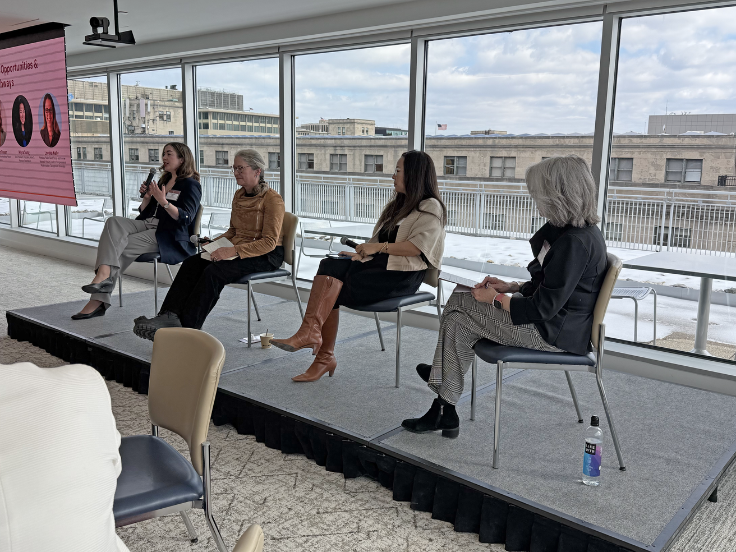
"There are so many opportunities that students aren't aware of that ties into the nationalization of our politics. There are 50 state houses around this country. [The Hill] is not the only place where you can start a career in politics. It's just the one that gets all of the media attention... I think we should de-nationalize the concept of public service and really highlight local and regional and state paths, not just as alternatives, but as equally good and sometimes better options."
Elizabeth Rosen
Panelists Elizabeth Rosen (Future Caucus), Lorelei Kelly (Public Good Group), Myra Sung (Peter G. Peterson Foundation), and moderator Mary K. Grant (president, Massachusetts College of Art and Design) held an informative discussion about new and emerging opportunities for higher education to more constructively engage with Congress and with governments at the state and local level. Discussion focused on both opportunities for students to deepen their civic leadership and on the many ways higher education research and resources can support a more inclusive civic infrastructure.
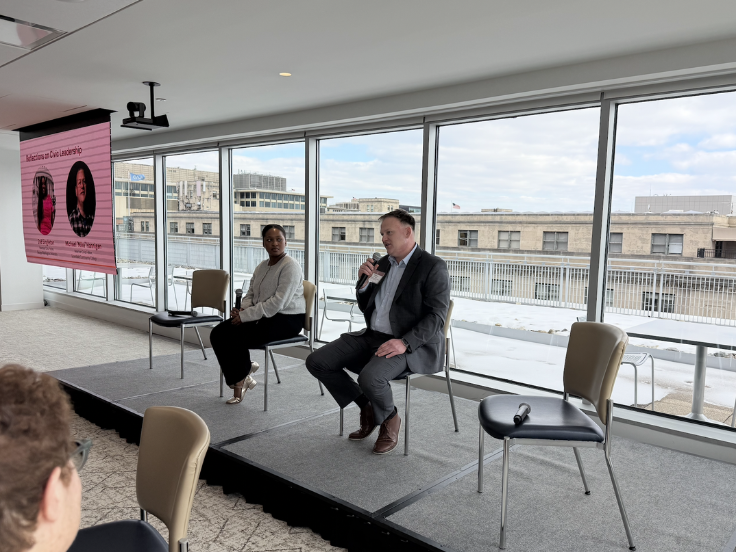
Reflections on Civic Leadership: Student Perspectives
“I like to define democracy as, loosely, everyone taking part in a governing system, for everyone’s voice holds the same weight in worldmaking. So, with that definition, the people have the power. The people have the responsibility. This responsibility is to make informed decisions and to make careful decisions. It’s important that as citizens, we have an education and a connection to the democracy we live under.”
- Zoë Singleton, student, The George Washington University
Two student leaders joined to share their perspectives on student civic engagement and how higher education can better support students of all ages to be more involved in our democracy.
Zoë Singleton, a senior at The George Washington University, spoke about the importance of civic education, especially in higher ed, in fostering informed and responsible citizenship. In particular, she highlighted ways college leaders can support students’ free expression, even in challenging contexts.
Mike Hannigan, a student and Newman Civic Fellow at Greenfield Community College, shared the story of his journey from a custodian to a student, made possible by a policy in Massachusetts that covers tuition and fees for adult learners. He encouraged Summit participants to champion programs that support students, especially those from diverse backgrounds, to engage adult learners and foster their civic leadership.
Reflections on Civic Leadership: Nancy Cantor
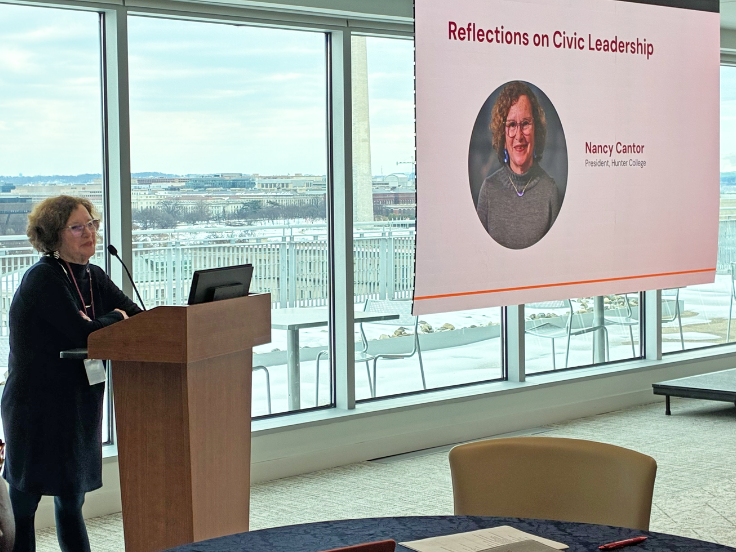
“Whether you're in the educational sector or you're in the government sector, there is a pressure right now to retreat from the public square into a stance of neutrality, and I don't think we can afford to do that. I think we have a responsibility… John Dewey, over 100 years ago, said democracy has to be reenacted in every generation. It's a simple statement, but it isn't pretty when we do it. Reenacting democracy is never neutral. It cannot be hiding under the cover.”
- Nancy Cantor
Nancy Cantor, president of Hunter College, joined to share some reflections on this moment and on higher education’s civic responsibility. She opened by acknowledging the pressure many institutions feel to retreat into neutrality—and pushed back on it. Drawing on the civil rights movement and thinkers like John Dewey, she argued that democracy has to be actively reenacted in every generation, and that higher education has a responsibility to be part of that. And, that to do this well, real civic engagement means building genuine two-way partnerships with communities. She argued that real change starts locally, requires listening first, and only works if we do it together.
Strategy Going Forward
After hearing from these insightful speakers, Summit participants spent time in smaller-group discussions to develop strategies for moving forward together. Groups focused on a new initiative that encourages individuals to serve as civic champions, building a federal agenda that supports civic engagement, and exploring new approaches to support students in their public service pathways.
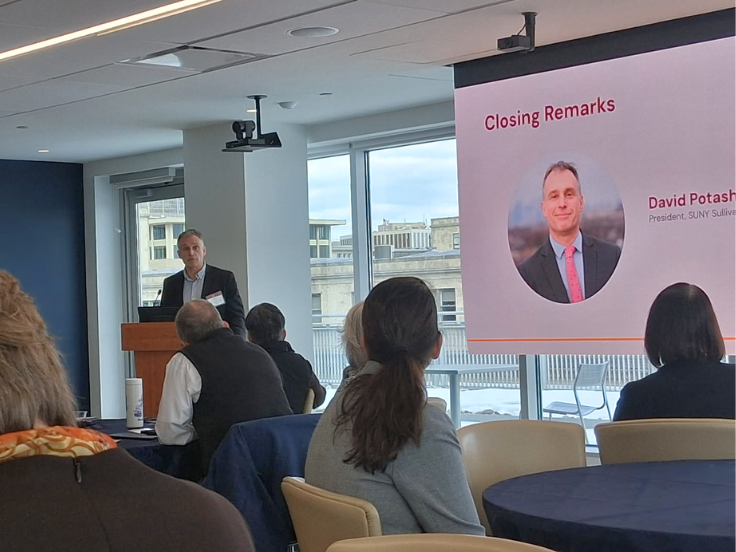
David Potash, president of SUNY Sullivan, shared a report-out at the end that summarized a few key takeaways, including:
- A framework offered by board member Lisa Freeman that captured the moment well—voice into action, into impact. Right now, we are in the voice stage. More voice must come before we can move toward meaningful action and lasting impact.
- The concept of “confianza,” which means far more than simple trust, but mutual respect and the recognition that people outside our institutions are not just stakeholders, but community members with valuable perspectives. It reflects something fundamental to higher education civic and community engagement—real partnerships rooted in mutual respect. Some of our most valuable future actions may be less about policy and more about elevating confianza within our institutions, among colleagues, and with the communities we serve.
- As he closed, President Potash invoked another phrase from that same tradition: en comunidad—in community, and how during the Summit, the community built was authentic and the foundation for important work to become real.