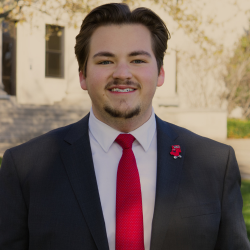
 By Caden Lucas
Western Kentucky University
The Rural Youth Voices Initiative seeks to empower rural youth to better serve their communities, reshape dominant narratives about rural engagement, and encourage rural-serving organizations to center youth voices. Twelve Fellows from across the United States received $500 and support from Campus Compact to support a narrative change or civic engagement project in their community.
On September 17, 2025, I stood in the middle of Western Kentucky University’s Centennial Mall and watched something unfold that I had only imagined a few weeks earlier. Students crowded around decorated tables stacked with pocket-sized Constitutions, music playing through campus speakers, and the scent of grilled burgers filled the air. But what struck me most wasn’t the free food or the giveaways. It was the sight of WKU students standing shoulder-to-shoulder with government officials, community leaders, and university administrators — all celebrating democracy together.
It may not sound radical. But in a rural college town like ours, moments like this can be rare. Too often, students walk past City Hall without knowing who works there. Too often, government leaders see students as temporary residents instead of future community builders. And too often, civic holidays like Constitution Day come and go without notice.
That disconnect is exactly why I wanted to do something different. Through the Rural Youth Voices Fellowship with Campus Compact, I asked a simple question: what if Constitution Day wasn’t just a date on the calendar, but a living tradition on our campus? What if one day of civic pride could plant the seeds of a campus culture that lasts for years?
Why Constitution Day?
I didn’t choose Constitution Day because it was convenient. I chose it because it’s overlooked. It doesn’t come with fireworks like the Fourth of July, or a long weekend like Labor Day. But maybe that’s the point. Democracy isn’t always flashy; it’s sustained. It’s built in everyday acts, intentional dialogue, and relationships between people who decide to show up.
For me, showing up meant asking WKU’s Student Government Association, our Political Science Department, the City of Bowling Green, and Warren County, Kentucky to co-create something new. That morning, when the Mayor, City Commissioners, and the County Judge-Executive signed a joint proclamation declaring September 17 as "Constitution Day,” I realized the project was bigger than one event. We weren’t just celebrating an old piece of paper from 1787. We were writing ourselves into the story of what civic life in rural America could become.
Impact & Reflections
The most powerful part of the day wasn’t the planning, the proclamation, or even the turnout. It was the voices of the people who were there. A classmate told me, “It was so fun to see friends from SGA, my sorority, and my dorm all come together for something civic. I hope we do more of this.”
Our Student Body President reflected, “Celebrating Constitution Day on campus is one of the first steps to bridging the gap between WKU and Bowling Green.” And a city official reminded us, “When higher education and local government work together, they create a bridge for open conversation, civic pride, and innovative solutions.”
Hearing those words, I knew we hadn’t just hosted a one-off event. We had begun something that felt joyful, rooted, and repeatable.
What Comes Next
Ultimately, Constitution Day was the spark. The fire is what we’re fostering now. This past year, I launched the Civic Engagement Resource Center (CERC) at WKU to provide students with year-round opportunities to connect civic learning with opportunities to become involved in community life and public service. Alongside it, we’re expanding the Hilltoppers Vote Coalition (HVC), a student-led effort to increase voter registration and turnout in our campus and surrounding community. Together, these initiatives aim to make civic engagement not an extracurricular, but a defining part of the student experience at WKU.
Why It Matters
I believe rural students deserve to see themselves in democracy; not as observers, but as participants. When students celebrate civic life, they begin to imagine futures where their voices matter in the places they live, not just the places they dream of moving to. They see that democracy isn’t abstract; it’s local. They see it when neighbors gather in Centennial Mall to share food, music, and a commitment to something bigger than themselves.
What happened at WKU can happen anywhere. It doesn’t require a massive budget or a perfect blueprint. It requires partnerships, intentionality, and a belief that students want to be part of the civic story.
A Call to Action
This is just the beginning. My hope is that other campuses, especially rural ones, will take Constitution Day or another overlooked civic holiday and turn it into something living, something joyful. Something that pulls students out of classrooms and into the community.
If you’re a student, faculty member, or civic leader reading this, I invite you to join me. Borrow our ideas, adapt them, make them your own. Together, we can ensure that students graduate not only with degrees, but with the civic habits and pride that strengthen our democracy.
To learn more about various civic initiatives at Western Kentucky University or to connect, please reach out to Caden Lucas.