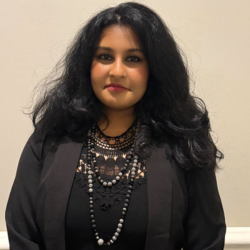
 By Preethika Yetukuri
Clemson University
The Rural Youth Voices Initiative seeks to empower rural youth to better serve their communities, reshape dominant narratives about rural engagement, and encourage rural-serving organizations to center youth voices. Twelve Fellows from across the United States received $500 and support from Campus Compact to support a narrative change or civic engagement project in their community.
I’ve spent much of my academic life navigating two worlds at once. On one hand, I am a student deeply immersed in advanced mathematics, data analysis, and research, spaces often associated with elite institutions and global conversations. On the other, I come from and remain connected to rural communities, where young people are too often spoken about but rarely spoken with. That tension, between visibility and invisibility, between ambition and access, has shaped how I think about civic engagement and whose voices are considered legitimate in policy spaces.
Too often, rural youth are framed through a deficit lens: lacking opportunity, lacking exposure, lacking resources. But in my experience, the issue is not a lack of ideas or motivation. It is a lack of infrastructure, the systems that turn lived experience into civic power. Rural students care deeply about education, healthcare, infrastructure, climate, and economic opportunity. What they often lack are clear pathways to translate those concerns into policy briefs, public narratives, or connections with decision-makers.
This gap became increasingly clear to me as I moved through leadership roles in research, service-learning, and civic engagement programs. I noticed that while many urban and suburban students were introduced early to policy writing, advocacy frameworks, and professional networks, rural youth were expected to “figure it out” on their own, often while facing additional barriers such as limited broadband, transportation challenges, or fewer mentorship opportunities. Civic engagement, in practice, was not equally accessible.
That realization led me to begin developing what I now call the Rural Voices Lab, a virtual-first civic engagement model designed to meet rural youth where they are and build structured pathways forward. The idea is simple, but ambitious: create a space where rural students can develop civic skills, produce SDG-aligned policy briefs and community action plans, and share their perspectives publicly through digital showcases. The Lab is intentionally designed to start online, accessible from a laptop, but with a longer-term vision of partnering with libraries and community centers to support students without reliable broadband.
At its core, the Rural Voices Lab is about building a civic opportunity ladder. Rather than treating civic participation as a one-off event, the Lab envisions a tiered pathway that begins locally and extends outward, connecting rural youth to regional, state, national, and even global networks. This includes workshops in critical thinking, storytelling, and policy writing, as well as mentorship and networking opportunities that make civic engagement feel not only possible, but sustainable.
What draws me to this work is not just the desire to amplify voices, but to rethink how civic systems are designed. Rural youth should not have to leave their communities, or abandon their identities, to be heard. Their perspectives are essential to shaping policies that affect education access, infrastructure investment, workforce development, and democratic participation itself. When rural voices are missing from these conversations, the resulting policies are incomplete.
This fellowship with the Rural Youth Voices Initiative has given me the space to slow down and design intentionally. Right now, my focus is on listening, prototyping, and learning, speaking with rural students about the issues they care about, identifying what kinds of support feel most useful, and drafting early templates for policy briefs and workshops. The goal is not to build something perfect overnight, but to build something responsive, grounded, and scalable.
I believe deeply that civic engagement should not be reserved for those with proximity to power. It should be something young people grow into, supported by tools, mentorship, and systems that recognize their lived experiences as expertise. Rural youth do not need saving. They need access, infrastructure, and trust.
As I continue developing the Rural Voices Lab, I am eager to learn from educators, community leaders, policymakers, and, most importantly, other rural students. If you are thinking about how to make civic engagement more inclusive, more representative, and more rooted in real communities, I hope this work invites you into conversation. This work is still unfolding, and I welcome conversation, critique, and collaboration along the way.