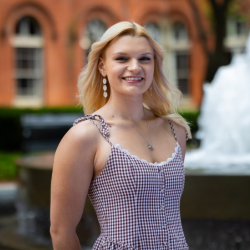
 By Lisa Kennedy
Georgetown University
The Rural Youth Voices Initiative seeks to empower rural youth to better serve their communities, reshape dominant narratives about rural engagement, and encourage rural-serving organizations to center youth voices. Twelve Fellows from across the United States received $500 and support from Campus Compact to support a narrative change or civic engagement project in their community.
I used to tell people, as shorthand, that I came from “the middle of nowhere.” To those on the outside, this nowhere exists only within reductive binaries. On one end, rurality consists of an idyllic agrarian utopia, its simple communities guided by an uncritical neighborliness. On the other, it descends into a caricature of ignorance and cultural decay, populated by people clinging to a bygone way of life.
But, my “nowhere” lies somewhere in the middle of that construction. For five generations, my family has stayed in this nowhere land. They scattered their homes along a single road, immersed in the great northwoods that kept our town alive. They spent their days working at the paper mill that sent the trees from our nowhere to towns they’d never been to and could hardly imagine. They loved, labored, and lived every day on this land —and their lives were filled with an inherent value that I couldn’t seem to reconcile with the binary conception of rurality held by most of my classmates and professors at Georgetown University.
It was my desire to challenge reductive conceptions of rurality and how those conceptions limit opportunity in rural America that led me to found Georgetown’s Association of Small Town and Rural Students, and serve as a Rural Advocacy Intern with the Rural Schools Collaborative, a Rural Engagement Intern at the US Department of Education, and this summer, a Fellow with the Rural Youth Voices Initiative.
For my project with the Rural Youth Voices Initiative, I initially sought to create a resource connecting students from my hometown of Rhinelander, Wisconsin to career professionals in or from the community. I had two main reasons for this. One, to help mitigate the brain drain and youth outward migration that so many rural communities like Rhinelander face. And two, to help Rhinelander students find mentors and role models who come from the same place as them. This helps show them that, whatever career path they’re interested in, there’s probably someone who’s done it before and so they know it can be done. It’s a resource I really wish I had myself when I was a young person in the rural community, as I was often taught that there were no opportunities for young people in rural communities like Rhinelander. It was this belief that drove me to leave.
I started by reaching out to Rhinelander High School staff and tapping into what is probably the most common public forum in rural communities today: Facebook groups. I sent around a post explaining who I was, what I was working on, and that I wanted Rhinelander High School Alumni involved in any career field and with any level of academic attainment to fill out a Google form if they’d be willing to serve as a potential mentor for students. Within a day, I had almost 30 responses and several people messaged me privately to let me know they’d like to get involved.
Among them was the high school counselor, who amazingly let me know that she’s been working on a similar initiative and was looking to create what she called “career academies” for high school students led by people living in the community. So as to not recreate the wheel, I sent her all my contacts and she’ll be integrating them into her database and career academies.
After that, I shifted gears. I also wanted to help amplify rural youth voices at my other home: Georgetown University. While I was a student there, I founded the Georgetown Association of Small Town and Rural Students—which we call Georgetown STARS for short. But, it wasn’t until this fall that the organization secured full university recognition. Georgetown STARS works to create a sense of community for rural students on Georgetown’s campus, which make up only 5% of the undergraduate population. This is due, in part, to unique barriers rural students face relative to their urban and suburban peers, like lower levels of parental education attainment, shorter letters of recommendation (likely due to teacher and counselor shortages), and lack of exposure to college.
I wanted to highlight a bit of the important work they do to support rural students on college campuses and advocate for increased geographic diversity at colleges like Georgetown. In September, I had the opportunity to return to DC for a weekend and I worked with the leadership of Georgetown STARS to organize an event focused on rural student belonging and activism on campus. We had an event with new and returning members alike—though it’s always been a small but mighty organization—and discussed topics ranging from student belonging, the transition to college, admissions advocacy, and the importance of increasing the proportion and visibility of rural students on college campuses.
We kicked things off with one of my favorite activities: introductions where everyone shares where they’re really from. Not just the nearest city, or a vague distance marker like “three hours north of Madison” or “forty minutes from the Upper Peninsula,” but the actual town, with all of its quirks and character. For me, that’s Rhinelander, Wisconsin — the home of the Hodag, a logging town in the northern part of the state. That small shift in how we introduced ourselves sparked a wave of conversation and connection. Students immediately began bonding over shared experiences and regional similarities. For many, it was the first time they felt like their rural identity wasn’t being brushed aside or explained away.
We were so engaged in the conversations that sparked from our introductions that we didn’t start the structured dialogue portion for about 30 minutes. We discussed the uncomfortable things like culture shock, gaps in cultural capital, feeling disconnected from wildlife and our families, and the often negative portrayal of rural America that too often pervades the classroom. But, we also discussed the reasons why we were ultimately grateful to be at Georgetown: the opportunities we never would have had in our hometowns, the people we’ve met with such varied life experiences, and having access to higher education—something too often denied from students from rural backgrounds.
After the event, I recorded brief interviews with most of the attendees. I asked each of them where they were from and what reminded them of home. It was a small way to keep those conversations moving and to document the diversity of rural identities on campus. I compiled those responses into a video, linked here.
Overall, it was a fun event and a great way for new and returning students to think about the way their rural background shapes the way they show up in the classroom and the importance of having such voices on college campuses. Moving forward, GU STARS hopes to continue collaborating with rural student groups on other college campuses, advocating for increased geographic diversity, and building community for rural students on Georgetown’s campus.
I’m very grateful to Hannah Botts, Will Brummet, the Rural Youth Voices Initiative cohort, and Campus Compact for their support with these projects and for providing space and support for rural youth leaders. Moving forward, I intend to continue advancing equity in rural, Indigenous, low-income, and other historically marginalized communities—always considering how place and power shape the world we live in.